
Small businesses in the restaurant and cafe industry face unique challenges when it comes to technology adoption. Limited budgets, minimal technical expertise, and the need for quick implementation often make restaurant owners hesitant to invest in digital solutions. However, a free online ordering system for small business can transform operations without breaking the bank. In this comprehensive guide, we explore how affordable digital ordering solutions can revolutionize your establishment in 2026.
Why Small Businesses Need Online Ordering Systems
The restaurant industry has undergone significant digital transformation, and customers now expect seamless online ordering experiences. For small businesses, having an online ordering system is no longer optional it's essential for survival and growth. Studies show that restaurants offering online ordering see an average increase of 20-30% in order value compared to phone orders.
Small restaurants and cafes often rely heavily on phone orders and walk-in customers. While this traditional approach has served businesses well for decades, it comes with limitations. Phone orders can lead to miscommunication, missed orders during peak hours, and lost revenue opportunities. A free online ordering system for small business eliminates these issues by providing a clear, visual menu that customers can browse at their leisure.
Benefits of Free Online Ordering Systems
Cost-Effective Solution: The most obvious benefit of a free online ordering system is the zero initial investment. Small businesses can access professional-grade ordering features without monthly subscription fees cutting into already thin profit margins.
Increased Order Accuracy: When customers place orders directly through an online interface, they select their items, customize options, and review their complete order before submission. This drastically reduces errors caused by misheard phone orders or hurried note-taking.
Enhanced Customer Experience: Modern consumers prefer digital interactions. A user-friendly online ordering system with categories, search functionality, and customization options creates a positive impression and encourages repeat business.
Valuable Customer Data: Unlike phone orders, online transactions generate valuable data about customer preferences, ordering patterns, and peak hours. This information becomes crucial for inventory management and targeted marketing campaigns.
Operational Efficiency: Orders flow directly into your kitchen display system, reducing the time staff spend relaying information and allowing them to focus on food preparation and customer service.
Key Features to Look for in Free Online Ordering Systems
Not all free online ordering systems are created equal. When evaluating options for your small business, prioritize platforms that offer comprehensive features without hidden costs:
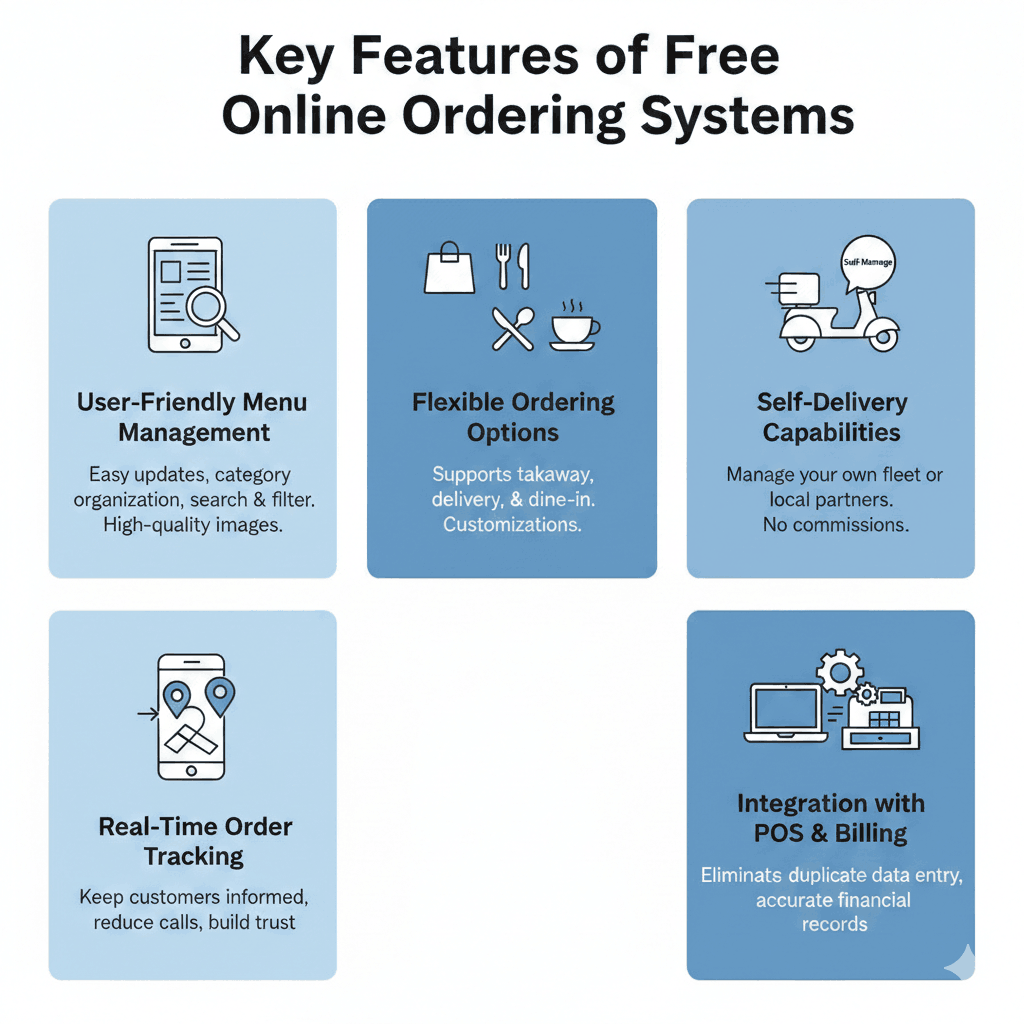
User-Friendly Menu Management
Your chosen system should allow easy menu updates, category organization, and item descriptions. Customers should be able to quickly find what they want using search and filter options. High-quality images and detailed descriptions help drive sales and set proper expectations.
Digital Menu Capabilities
At the heart of any successful online ordering system is a well-designed digital menu. Unlike traditional paper menus, digital menus offer dynamic updates, visual appeal, and interactive features that enhance the customer experience. A quality digital menu should support rich media like high-resolution food photography, detailed ingredient lists, nutritional information, and real-time availability updates. These features not only improve customer satisfaction but also reduce operational costs associated with printing and updating physical menus.
For restaurant owners looking to maximize the potential of their digital menu strategy, our digital menu for restaurants complete guide provides comprehensive insights into menu design best practices, optimization strategies, psychology of menu layout, and emerging trends for 2026. Understanding how to create an effective digital menu is essential for converting browsers into buyers and maximizing your average order value.
If you're specifically looking for a cost-effective solution without ongoing subscription fees, offering your menu online for free is entirely possible with the right platform. Many small businesses are discovering that free online restaurant menus provide all the essential functionality needed to showcase their offerings professionally while integrating seamlessly with ordering systems. For detailed guidance on creating, optimizing, and maintaining a free online menu that drives orders and enhances customer experience, explore our free online restaurant menu complete guide for 2026.
One of the most effective ways to bridge the gap between physical dining and digital ordering is through QR code menus. These scannable codes allow customers to access your full digital menu instantly using their smartphones, eliminating the need for physical menus while enabling seamless transitions from browsing to ordering. QR code menus have become particularly valuable for small businesses because they require minimal setup, work with existing customer devices, and can integrate directly with your online ordering system. For restaurants looking to implement QR code solutions that enhance both dine-in and takeaway experiences, our QR code menu for restaurants complete guide covers everything from generation and placement strategies to design best practices and integration with ordering platforms for 2026.
Beyond simply displaying menus, QR codes can transform the entire ordering experience when properly implemented. QR code ordering enables customers to scan, browse, customize, and complete their orders entirely from their mobile devices—whether they're dining in, waiting for takeaway, or even ordering from outside your establishment. This technology eliminates wait times, reduces staff workload, and provides a frictionless ordering experience that modern customers expect. For small businesses ready to implement a complete QR code ordering solution that integrates seamlessly with their operations, our QR code ordering for restaurants complete guide provides detailed implementation strategies, best practices for customer adoption, technical setup instructions, and proven tactics for maximizing order volume through QR-based ordering systems in 2026.
While digital menus for online ordering are crucial, many forward-thinking restaurants are also integrating digital menu board screens into their physical locations to create a unified digital experience. These large-format displays showcase your menu with vivid imagery and dynamic content that captures customer attention while they wait in line or dine in. Digital menu boards complement your online ordering system by maintaining consistent branding, pricing, and promotions across all customer touchpoints. For comprehensive information on selecting the right hardware, content strategies, and ROI optimization for in-store digital displays, explore our digital menu board screens complete guide for 2026.
TV Menu Display Solutions
As restaurants continue to enhance their visual presence and customer experience, TV menu displays have become an increasingly popular solution for showcasing offerings in an engaging, modern format. TV menus offer larger display areas than traditional menu boards, making them ideal for restaurants with extensive menus or locations where customers view menus from a distance. These displays are particularly effective in fast-casual dining environments, cafeterias, food courts, and quick-service restaurants where customers need to quickly scan menu options while waiting in line.
Implementing TV menu displays involves selecting the right screen size and resolution, creating visually appealing templates that showcase your items effectively, and ensuring content remains fresh and aligned with your current offerings. For restaurant owners looking to implement TV menu solutions that capture attention, reduce perceived wait times, and drive higher order values, our TV menu template complete guide for restaurants 2026 provides comprehensive insights into template design, content strategies, hardware selection, and best practices for creating impactful TV menu displays that integrate seamlessly with your online ordering ecosystem.
Flexible Ordering Options
Today's customers want choices. The ideal system supports takeaway, delivery, and dine-in options. Online ordering platforms should also accommodate customizations like size selection, extra toppings, and special dietary instructions.
Specialized Solutions for Takeout Operations
As takeout orders continue to represent a significant revenue stream for restaurants, specialized takeout apps have emerged to address the unique operational challenges of off-premise dining. Unlike generic ordering systems, dedicated takeout solutions focus specifically on optimizing the pickup experience with features like curbside coordination, precise timing controls, and streamlined packaging workflows that ensure food quality during transport.
For restaurants looking to maximize their takeout operations, understanding the landscape of available solutions can significantly impact efficiency and customer satisfaction. Popular platforms like Toast have developed comprehensive takeout capabilities that integrate order management, payment processing, and customer communication. Our Toast Takeout App complete guide provides detailed insights into Toast's takeout features, pricing structure, implementation process, and alternative solutions for 2026, helping you determine whether this platform aligns with your business needs and budget.
Self-Service and Autonomous Ordering
As customer preferences evolve toward greater independence and control, self-service food ordering has emerged as one of the most impactful trends reshaping the restaurant industry. Self-service ordering empowers customers to browse menus, customize their meals, and complete transactions entirely on their own terms—whether through tabletop tablets, wall-mounted kiosks, or their personal mobile devices. This approach not only enhances customer satisfaction by eliminating wait times and order errors but also significantly improves operational efficiency by freeing staff to focus on food preparation and hospitality rather than order taking.
For small businesses exploring how self-service ordering can transform their operations, reduce labor costs, and create a more modern dining experience, our self-service food ordering complete guide for 2026 provides comprehensive insights into implementation strategies, hardware and software options, customer adoption techniques, and best practices for integrating self-service capabilities with your existing online ordering system.
Within the self-service ordering landscape, self-service kiosks have become particularly transformative for fast food establishments. These standalone terminals provide customers with intuitive touchscreen interfaces for browsing menus, customizing orders, and completing payments—all without staff intervention. Fast food restaurants especially benefit from kiosks during peak hours when speed and order accuracy are critical. Self-service kiosks not only reduce perceived wait times but also encourage larger orders through strategic upselling prompts and visual menu displays. For fast food operators looking to implement kiosk solutions that increase throughput, boost average order values, and enhance the customer experience, our self-service kiosk fast food complete guide for 2026 offers comprehensive guidance on selecting hardware, optimizing kiosk placement, designing effective user interfaces, and maximizing ROI from self-service kiosk investments.
Industry-Specific Ordering Solutions
While general online ordering systems work well for most restaurants, certain food businesses benefit from specialized solutions tailored to their unique operational needs. Pizza restaurants, for example, face distinct challenges including complex topping combinations, multiple size and crust options, half-and-half pizzas, and group ordering scenarios that require more sophisticated ordering interfaces than standard restaurant menus.
For pizzeria owners looking to optimize their digital ordering experience with features specifically designed for pizza operations—such as visual pizza builders, topping calculators, heat maps for ingredient placement, and bundle deals—our pizza ordering software complete guide for 2026 provides comprehensive insights into selecting and implementing pizza-specific ordering technology. Understanding these specialized features can significantly improve order accuracy, customer satisfaction, and operational efficiency for pizza-focused businesses.
Optimizing Pickup Orders for Food Businesses
Among the various ordering options, pickup orders have emerged as one of the most profitable and operationally efficient channels for small restaurants. Pickup orders eliminate delivery logistics and third-party commissions while providing customers with the convenience of pre-ordering and quick collection. When implemented effectively, a well-optimized pickup system can significantly increase order volume during peak hours, improve kitchen workflow, and enhance customer satisfaction through reduced wait times.
For small businesses looking to maximize the potential of their pickup operations, understanding best practices for order timing, customer communication, designated pickup areas, and streamlined handoff procedures is essential. Our pickup orders food complete guide for 2026 provides comprehensive strategies for implementing, optimizing, and scaling your pickup order operations to drive profitability while delivering exceptional customer experiences.
Choosing the Right Online Food Selling Platform
When implementing an online ordering system, small business owners must decide between using dedicated online food selling apps or building their own branded ordering platform. Online food selling apps come in various forms—from third-party marketplaces that aggregate multiple restaurants to white-label solutions that let you maintain your brand identity while leveraging established technology infrastructure.
Each approach offers distinct advantages and challenges. Third-party apps provide instant access to a large customer base but charge significant commissions and limit your control over customer data and relationships. Self-hosted solutions offer complete ownership and zero commission fees but require more setup effort and marketing to drive initial traffic. Understanding these trade-offs is crucial for making the right choice for your business model and growth stage.
For restaurant owners evaluating different platforms and wondering which type of online food selling app best fits their needs, our online food selling apps complete guide provides detailed comparisons of platform types, commission structures, feature sets, and strategic recommendations for maximizing profitability in 2026.
Building Your Online Restaurant Presence
As your small business grows its digital footprint, having a professional online restaurant website becomes increasingly important. While a basic online ordering interface allows customers to place orders, a comprehensive restaurant website serves as your digital storefront, showcasing your brand story, ambiance, location information, and full menu alongside ordering capabilities. A well-designed website builds credibility, improves local search visibility, and gives customers confidence in your establishment before they place their first order.
For restaurant owners ready to elevate their online presence beyond basic ordering functionality, our online restaurant website complete guide for 2026 covers everything from website design best practices and essential features to SEO optimization, mobile responsiveness, and integration with your ordering system. Understanding how to create an effective restaurant website helps you attract more customers and build a stronger brand in an increasingly digital marketplace.
Comprehensive Restaurant Apps for Modern Operations
As the restaurant technology landscape continues to evolve, many small business owners are exploring comprehensive restaurant apps that go beyond simple online ordering. These multifunctional applications integrate various aspects of restaurant operations—from customer-facing ordering interfaces to back-end management tools, loyalty programs, reservation systems, and analytics dashboards. Understanding the full spectrum of restaurant app capabilities helps small businesses make informed decisions about which features matter most for their specific operational needs.
For restaurant owners looking to understand the broader ecosystem of restaurant applications, including mobile ordering apps, kitchen management tools, staff scheduling platforms, and integrated business management solutions, our restaurant apps complete guide for 2026 provides comprehensive insights into selecting, implementing, and maximizing the value of restaurant technology. This resource helps you determine which app features align with your growth strategy and operational priorities.
Order Machine Integration and Self-Service Capabilities
As restaurants continue to modernize their operations, order machines have emerged as powerful tools that complement online ordering systems by providing self-service ordering capabilities directly in your physical location. Order machines—also known as self-service kiosks—reduce wait times, increase order accuracy, and free up staff to focus on food preparation and customer service rather than order taking. These devices work seamlessly alongside your online ordering platform, sharing the same menu database and order management system.
For small businesses considering whether order machines make sense for their operations, or for those looking to optimize existing kiosk implementations, our order machine restaurant complete guide for 2026 provides comprehensive insights into hardware options, software integration, placement strategies, customer adoption techniques, and ROI optimization. Understanding how order machines fit into your broader digital ordering ecosystem helps you create a cohesive omnichannel experience that meets customers wherever they prefer to order.
Mobile Order Pickup Functionality
One of the fastest-growing trends in restaurant technology is mobile order pickup, which combines the convenience of online ordering with the efficiency of in-person collection. Customers increasingly prefer to order ahead from their smartphones and pick up their meals without waiting in line or dealing with phone orders. This ordering method offers significant benefits for small businesses: reduced wait times, improved order accuracy, better labor efficiency during peak hours, and enhanced customer satisfaction.
A quality online ordering system should include robust mobile order pickup features such as estimated ready times, pickup notifications, designated pickup areas, and clear communication channels for arrival notifications. These capabilities ensure smooth operations and prevent bottlenecks during busy periods. For small businesses looking to implement or optimize their mobile pickup operations, our mobile order pickup complete guide covers everything from system setup and workflow optimization to customer communication strategies and best practices for 2026.
Streamlined Order Taking Capabilities
While customer-facing online ordering is essential, many small restaurants also need efficient tools for staff to take orders on behalf of customers—whether over the phone, at the counter, or tableside. An order taking application provides your team with the same intuitive interface customers use, but with additional capabilities designed for staff efficiency. These applications enable faster order entry, real-time menu updates that prevent offering out-of-stock items, and seamless integration with kitchen operations.
The right order taking application transforms how your staff handles orders during peak hours, reducing errors and improving speed of service. For restaurant owners looking to understand how order taking applications fit into their overall ordering ecosystem and how to select the best solution for their specific needs, our order taking application complete guide for 2026 provides detailed insights into features, implementation strategies, staff training approaches, and integration with other restaurant management tools.
Understanding Digital Food Ordering Systems
As you evaluate different online ordering solutions for your small business, it's important to understand the broader landscape of digital food ordering technology. Modern digital food ordering systems encompass everything from basic web-based order forms to sophisticated platforms with integrated payment processing, kitchen management, and customer relationship tools. These comprehensive systems are designed to handle the entire ordering workflow—from customer browsing to kitchen preparation to delivery or pickup.
For restaurant owners who want to dive deeper into how digital food ordering systems work, what features matter most, and how to choose the right solution for your specific business needs, our digital food ordering system complete guide provides comprehensive insights into system architecture, integration capabilities, and implementation strategies for 2026. Understanding these fundamentals will help you make more informed decisions when selecting features for your ordering platform.
Contactless and Touch-Free Capabilities
As customer preferences continue to evolve, contactless ordering has become a standard expectation rather than a novelty. The ability for customers to browse menus and place orders without physical contact—whether through QR codes, mobile apps, or web interfaces—not only improves convenience but also addresses ongoing health and safety concerns. For small businesses looking to implement these modern ordering methods, our contactless menu ordering guide provides detailed strategies and implementation tips for 2026.
Beyond basic contactless ordering, many restaurants are now adopting comprehensive contactless menu solutions that integrate QR code menus, digital ordering, and touchless payment systems. These complete systems offer enhanced customer experiences while streamlining restaurant operations. For a deeper dive into implementing a full contactless menu ecosystem, including QR menu creation, customer engagement strategies, and best practices for 2026, check out our contactless restaurant menu complete guide.
Food Delivery Service Integration
One of the most critical decisions small restaurant owners face is how to handle delivery operations. Third-party delivery services charge significant commissions—often 15-30% per order—that eat into already thin profit margins. However, managing your own delivery operations comes with its own challenges, including driver management, route optimization, and liability considerations.
The right online ordering system should offer flexible delivery options that let you choose the approach that best fits your business model. Whether you opt for third-party platforms, build your own delivery fleet, or use a hybrid approach, understanding the full landscape of food delivery services is essential for making informed decisions that protect your profitability while meeting customer expectations.
For restaurant owners navigating the complex world of delivery logistics, commission structures, and operational strategies, our food delivery services for restaurants complete guide provides comprehensive insights into evaluating delivery partners, implementing self-delivery systems, optimizing delivery zones and fees, and maximizing profitability from delivery orders in 2026.
Restaurant Delivery Software Solutions
Beyond choosing between third-party services and self-delivery, small restaurant owners increasingly need sophisticated restaurant delivery software to manage the complexities of modern delivery operations. Whether you're handling your own deliveries or coordinating multiple delivery channels, the right delivery software streamlines dispatch management, route optimization, driver tracking, and customer communication—all while integrating seamlessly with your online ordering system.
Restaurant delivery software helps small businesses maintain quality control over the delivery experience, reduce delivery times, minimize errors, and provide customers with real-time tracking and updates. For restaurants ready to optimize their delivery operations with professional-grade technology, our restaurant delivery software complete guide for 2026 covers everything from software selection criteria and feature comparison to implementation strategies, driver management best practices, and ROI optimization for delivery operations.
Real-Time Order Tracking
Customers appreciate transparency. Real-time order tracking and notifications keep customers informed about their order status, reducing anxious phone calls and building trust in your service.
Integration with POS and Billing
For maximum efficiency, your online ordering system should integrate seamlessly with your restaurant's billing software. This integration eliminates duplicate data entry and ensures accurate financial records.
Custom Restaurant Apps: Taking Your Ordering System Further
While web-based online ordering systems provide excellent functionality for most small businesses, some restaurants may eventually consider developing a custom restaurant app as they grow. A branded mobile application can offer enhanced customer engagement, push notifications for promotions, and deeper loyalty program integration. However, this path requires careful consideration of development costs, maintenance requirements, and whether your customer base would actively use a dedicated app.
For restaurant owners exploring whether a custom app makes sense for their business model, our custom restaurant app complete guide covers everything from cost-benefit analysis to development approaches and feature planning for 2026. This resource helps you determine if investing in a custom app aligns with your growth strategy or if a web-based solution better serves your needs.
As mobile ordering continues to dominate the restaurant technology landscape, many small business owners are also considering dedicated restaurant mobile apps to complement their web-based ordering systems. A well-designed mobile app provides customers with a streamlined, always-accessible ordering experience optimized specifically for smartphones, offering features like one-tap reordering, saved payment methods, location-based promotions, and personalized recommendations. For comprehensive guidance on evaluating whether a mobile app is right for your restaurant, understanding the differences between native apps and progressive web apps, and implementing a successful mobile ordering strategy, explore our restaurant mobile app complete guide for 2026.
How Digital Eatery Supports Small Businesses
Digital Eatery understands the unique needs of small restaurant and cafe businesses. Our platform provides a robust free online ordering system for small business operations, designed with simplicity and efficiency in mind.
With features like intuitive menu browsing, customizable food options, and real-time order tracking, restaurant owners can offer customers a premium ordering experience without premium costs. The platform's intuitive billing interface works alongside the online ordering system, creating a unified solution for order management and payment processing.
Small businesses particularly benefit from our loyalty program integration. Enrolling customers in reward programs becomes automatic with each online order, helping you build lasting relationships and encourage repeat visits without additional marketing effort.
Getting Started with Free Online Ordering
Implementing an online ordering system for your small business doesn't require technical expertise or lengthy training. Follow these steps to get started:
1. Assess Your Current Operations: Identify your most popular items, peak ordering times, and common customer questions. This information helps you configure your system effectively.
2. Set Up Your Menu: Upload your menu with clear categories, appealing descriptions, and accurate pricing. Include high-quality photos of your best dishes to encourage orders.
3. Configure Ordering Options: Decide which services you'll offer takeaway, delivery, or dine-in. Set your delivery zones, minimum order amounts, and preparation time estimates.
4. Train Your Staff: While online ordering reduces manual tasks, your team should understand how orders appear in your system and how to handle any customer inquiries.
5. Promote Your New Channel: Let customers know about your online ordering capability through social media, table tents, and word-of-mouth. Consider offering a small discount for first-time online orders to encourage adoption.
Maximizing ROI from Your Online Ordering System
A free online ordering system becomes truly valuable when leveraged strategically. Use the customer data collected to identify trends, adjust your menu offerings, and create targeted promotions. The customer data management features enable retargeting with personalized offers, turning occasional customers into regulars.
Monitor your online ordering metrics regularly. Track average order values, popular items, peak ordering times, and customer feedback. This data-driven approach helps you make informed decisions about menu changes, staffing, and promotional strategies.
Consider combining your online ordering system with promotional tools. Create vouchers and discounts that incentivize larger orders or introduce new menu items. These marketing capabilities turn your ordering platform into a revenue-generating tool beyond simple transaction processing.
Conclusion
A free online ordering system for small business operations represents one of the smartest investments restaurant and cafe owners can make in 2026. The combination of zero upfront costs, operational efficiency, improved customer experience, and valuable data insights creates a compelling case for digital transformation.
Small businesses no longer need to choose between affordability and functionality. Platforms like Digital Eatery provide comprehensive features that level the playing field, allowing independent restaurants and cafes to compete effectively with larger chains.
The restaurant industry continues evolving, and customer expectations grow accordingly. By implementing a free online ordering system today, your small business positions itself for success tomorrow. Start exploring your options and take the first step toward streamlined operations and increased revenue.
Published with LeafPad