
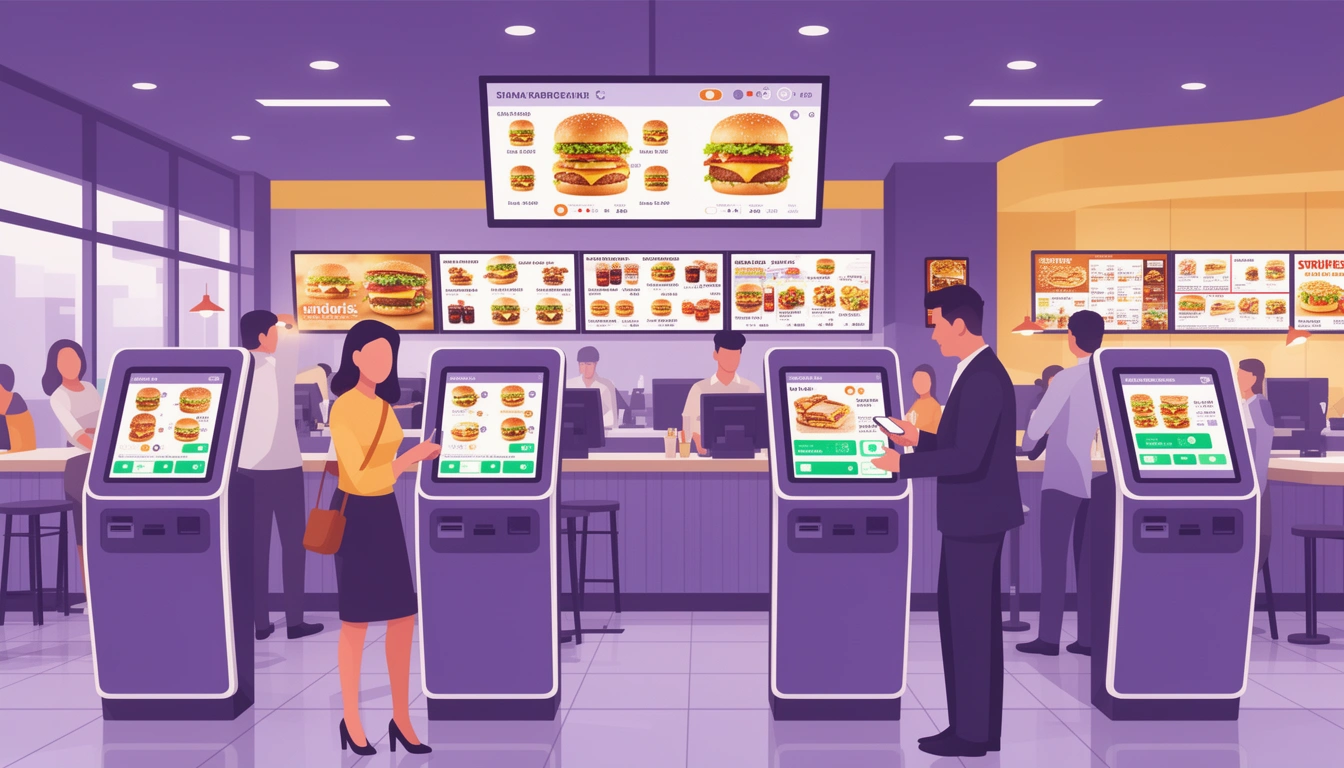
Fast food restaurants are experiencing a revolution in customer service, and self-service kiosks are leading the charge. These interactive touchscreens are transforming how customers order, pay, and interact with quick-service establishments. If you're considering implementing this technology in your restaurant, this comprehensive guide will walk you through everything you need to know.
What Is a Self-Service Kiosk for Fast Food?
A self-service kiosk is an interactive digital terminal that allows customers to browse menus, customize orders, and complete payments without direct staff interaction. These standalone devices typically feature large touchscreens, payment processing capabilities, and integration with your restaurant's point-of-sale system.
Modern kiosks have evolved far beyond simple ordering machines. They now offer sophisticated features like visual menu displays, customization options, upselling prompts, and loyalty program integration all designed to enhance the customer experience while improving operational efficiency.
Benefits of Self-Service Kiosks in Fast Food Restaurants
Increased Order Accuracy
One of the most significant advantages of self-service kiosks is the dramatic reduction in order errors. When customers input their own orders, miscommunication between staff and customers is eliminated. This leads to fewer remakes, reduced food waste, and higher customer satisfaction.
Higher Average Order Values
Studies consistently show that customers spend 15-30% more when ordering through kiosks compared to traditional counter ordering. The technology strategically suggests add-ons, upgrades, and complementary items without the social pressure customers might feel when interacting with staff. Customers take their time exploring menu options and feel more comfortable customizing their orders.
Reduced Labor Costs
While kiosks don't eliminate the need for staff, they allow you to reallocate team members to higher-value tasks like food preparation, quality control, and customer service. During peak hours, kiosks handle the surge in orders without requiring additional cashiers.
Faster Service During Rush Hours
Multiple kiosks can serve several customers simultaneously, eliminating long queues during busy periods. Customers can browse menus at their own pace without feeling rushed, while those ready to order can complete transactions quickly.
Enhanced Customer Experience
Today's consumers appreciate control and convenience. Kiosks provide privacy for placing orders, eliminate language barriers with multilingual options, and display high-quality images of menu items. The visual interface helps customers make informed decisions about their meals.
Key Features to Look for in Fast Food Kiosks
Intuitive User Interface
The kiosk interface should be simple enough for first-time users to navigate without assistance. Large buttons, clear categories, and logical menu flow are essential. The system should accommodate users of all ages and tech-savviness levels.
Customization Capabilities
Your kiosk should allow customers to modify orders easily selecting sizes, adding or removing ingredients, and specifying special instructions. This flexibility is crucial for fast food establishments where customization is expected.
Multiple Payment Options
Modern kiosks should accept various payment methods including credit/debit cards, mobile wallets, contactless payments, and even cash (with appropriate hardware). The more payment options available, the smoother the customer experience.
Integration with Existing Systems
Your kiosk must seamlessly integrate with your restaurant billing software and kitchen display system. This ensures orders flow directly to the kitchen without manual intervention, maintaining order accuracy and speed.
Loyalty Program Integration
The ability to identify loyalty members, apply rewards, and earn points through the kiosk encourages repeat visits and builds customer engagement. Digital Eatery's platform makes this integration straightforward with built-in customer management features.
How Self-Service Kiosks Compare to Other Ordering Methods
While kiosks are powerful tools, they work best as part of an omnichannel strategy. They complement rather than replace other ordering methods.
Compared to self-service food ordering through mobile apps, kiosks serve walk-in customers who haven't downloaded your app. They're particularly effective for first-time visitors and customers who prefer in-person ordering.
Unlike traditional order machines, modern kiosks offer rich visual experiences with high-resolution images, videos, and interactive elements that drive engagement and sales.
Implementation Costs and ROI
Initial Investment
Self-service kiosks typically range from $2,000 to $8,000 per unit, depending on features, hardware quality, and software capabilities. Most fast food restaurants start with 2-4 kiosks to adequately serve customer demand.
However, cloud-based solutions like Digital Eatery offer more affordable alternatives. By using tablets or existing hardware with sophisticated software, you can implement self-service ordering at a fraction of traditional kiosk costs.
Ongoing Costs
Factor in monthly software subscriptions (typically $50-$200 per kiosk), maintenance, and occasional hardware upgrades. Quality kiosks should last 5-7 years with proper care.
Expected ROI
Most fast food restaurants report recovering their kiosk investment within 12-18 months through increased average order values, reduced labor costs, and improved order accuracy. The long-term benefits extend well beyond initial cost recovery.
Best Practices for Kiosk Deployment
Strategic Placement
Position kiosks near the entrance but not blocking the flow of traffic. Ensure they're visible to entering customers and place them in well-lit areas. Consider customer traffic patterns and maintain space for queues.
Staff Training
Train team members to assist customers with kiosk ordering, especially during the initial rollout. Staff should monitor kiosks during busy periods and proactively help hesitant users.
Clear Signage
Use simple, welcoming signs to encourage kiosk use. Highlight benefits like "Skip the line" or "Order your way" to motivate adoption. Consider multilingual signage in diverse communities.
Maintain Multiple Ordering Options
Never force customers to use kiosks exclusively. Always maintain traditional counter ordering for customers who prefer human interaction. The goal is to offer choice, not eliminate service.
Overcoming Common Challenges
Customer Adoption
Some customers, particularly older demographics, may resist new technology. Combat this with patient staff assistance, simple interfaces, and incentives for first-time kiosk users. Over time, adoption rates typically exceed 70-80% in most establishments.
Technical Issues
Prepare for occasional technical glitches with reliable support from your kiosk provider. Regular maintenance, software updates, and backup ordering systems ensure minimal disruption during downtime.
Cleanliness Concerns
In the post-pandemic era, customers notice cleanliness. Establish regular sanitization schedules, provide hand sanitizer near kiosks, and consider antimicrobial screen protectors to address hygiene concerns.
Digital Eatery's Self-Service Solution
Digital Eatery offers a comprehensive online ordering platform that extends to self-service kiosk functionality. Our solution provides:
- Tablet-based kiosk setup using affordable hardware
- Seamless integration with billing and kitchen display systems
- Customizable menu presentation with images and descriptions
- Built-in loyalty program and customer data collection
- Real-time order tracking and kitchen communication
- Multiple payment gateway support
- Cloud-based management for easy updates across all devices
Unlike expensive proprietary kiosk systems, Digital Eatery's flexible platform works with standard tablets and hardware, dramatically reducing implementation costs while maintaining professional functionality.
Future Trends in Self-Service Kiosks
The kiosk landscape continues evolving with emerging technologies. AI-powered recommendation engines are becoming more sophisticated, suggesting items based on time of day, weather, and customer preferences. Voice ordering capabilities are being integrated for accessibility and convenience.
Facial recognition for loyalty member identification, augmented reality menu visualization, and predictive ordering based on customer history represent the next frontier in self-service technology.
Is a Self-Service Kiosk Right for Your Fast Food Restaurant?
Self-service kiosks make the most sense for establishments that:
- Experience high customer volume during peak hours
- Offer customizable menu items
- Want to increase average order values
- Struggle with order accuracy issues
- Serve tech-comfortable demographics
- Have limited counter space for multiple cashiers
If your fast food restaurant checks several of these boxes, kiosks could significantly improve operations and profitability.
Getting Started with Self-Service Kiosks
Begin by analyzing your customer flow and identifying pain points in the current ordering process. Calculate potential ROI based on your average order values and customer volume. Research solutions that integrate with your existing systems.
Start small with 1-2 kiosks to test customer acceptance and gather feedback. Monitor usage rates, average order values, and customer satisfaction before expanding. Use data to refine the interface and menu presentation.
Digital Eatery makes implementation straightforward with our all-in-one platform. You can set up self-service ordering on tablets positioned throughout your restaurant, integrated seamlessly with your billing system and kitchen displays. Our solution grows with your business, from a single location to multiple outlets.
Conclusion
Self-service kiosks represent a proven investment for fast food restaurants looking to modernize operations, increase revenue, and meet evolving customer expectations. The technology has matured beyond early adoption challenges, offering reliable, cost-effective solutions that deliver measurable results.
Whether you choose traditional standalone kiosks or flexible tablet-based solutions like Digital Eatery, the key is selecting a system that integrates seamlessly with your operations and provides excellent customer experience. As consumer preference for self-service continues growing, implementing kiosks positions your fast food restaurant for long-term success in an increasingly digital marketplace.
Ready to explore self-service ordering for your restaurant? Digital Eatery's platform offers everything you need to implement kiosk ordering, manage operations, and grow your business all in one affordable solution.
Published with LeafPad